Analyzing the composition of symbiotic Dinoflagellates (Symbiodiniaceae) in the reef-building coral Galaxea fascicularis in relation to environmental factors and species-co-occurrences.
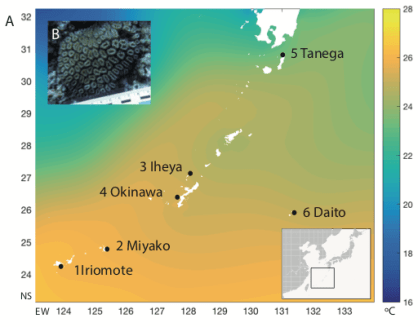
A: Study area marking the six sampling sites across the Ryukyu Archipelago and showing annual average sea surface temperature. B: Example photograph of the host Galaxea fascicularis.
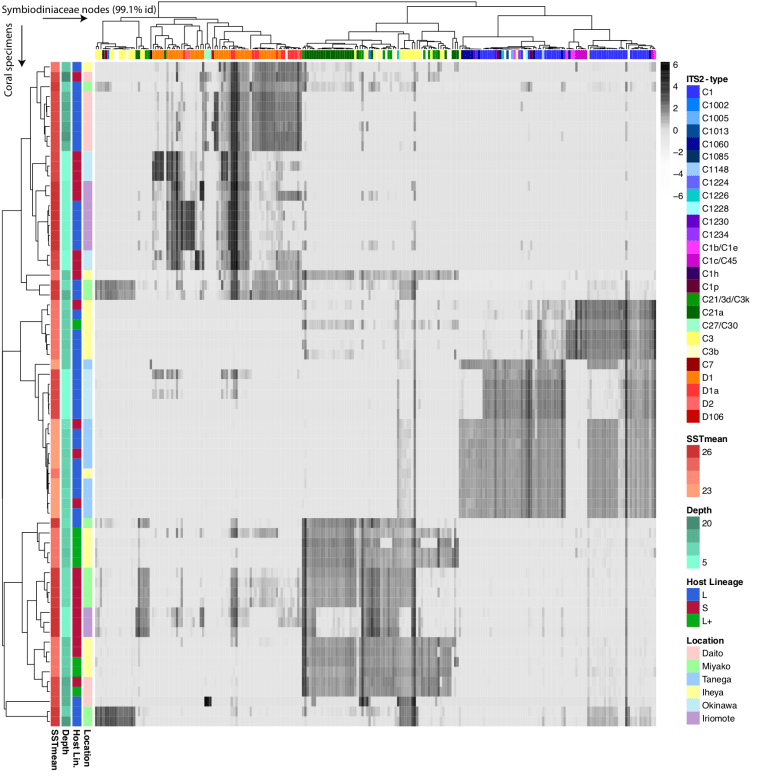
Symbiont communities clustered into regular groups, largely independent from location, temperature and depth!
Heatmap showing the abundance of Symbiodiniaceae ITS2 types (columns) in coral colonies (rows). Darker cells indicate higher abundance. The Symbiodiniaceae (columns) are colored according to their ITS2-type. The coral colonies (rows) are colored according to sampling location, annual mean sea surface temperature (SSTmean), depth of occurrence, and genetic identity (host lineage).
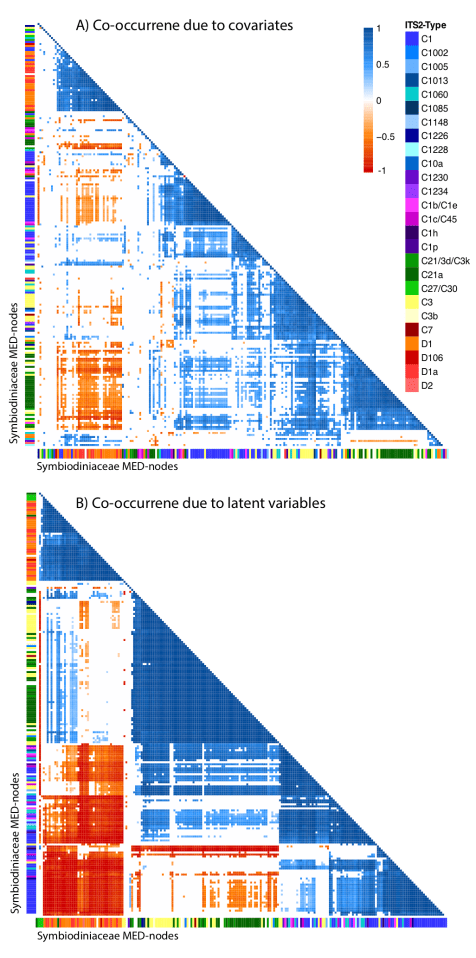
Coral symbionts could form their communities due to inter-specific interactions, as analyzed by a Latent Variable-approach in a joint-species-distribution model (Boral, R).
Correlations of Symbiodiniaceae ITS2-types based on exogenous factors (SST, depth, host lineage, host bleaching, host polyp size, location; A) and based on latent variables (B). Most co-occurrences seem to be explained by residual correlations (strong correlations in B).


 Patricia Himeka Wepfer